The phrase “digital cosmetic dentistry in Mumbai” can describe anything from photographs and an intraoral scan to a connected workflow using CBCT, CAD/CAM and 3D printing. You will be able to identify which technology your procedure actually needs, understand what each scan contributes, and question previews that promise more than digital planning can deliver.
Key takeaways
- Ask which records support your digital smile plan, including photographs, scans and X-rays.
- Confirm whether the proposed restoration is milled, printed or made by a dental laboratory.
- Match each procedure to the scan it needs; veneers do not require every available scan.
- Request a preview, treatment sequence and explanation of how digital designs become restorations.
Which digital devices are included in cosmetic dental care?
Digital technology included in cosmetic dental care in Mumbai ranges from cameras and scanners to design and manufacturing systems. Each device captures a different layer of information, so a computer-generated smile is only as useful as the records behind it.
| Device | Data captured | Cosmetic use |
|---|---|---|
| Digital photographs | Tooth colour, lip position, tooth display and facial proportions | Baseline assessment, shade comparison and smile planning |
| Facial scanner | Soft-tissue contours and facial reference lines | Relating tooth position to the lips and face |
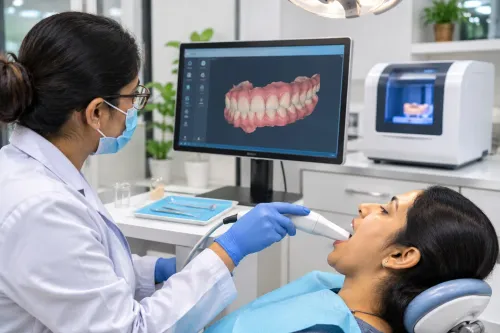
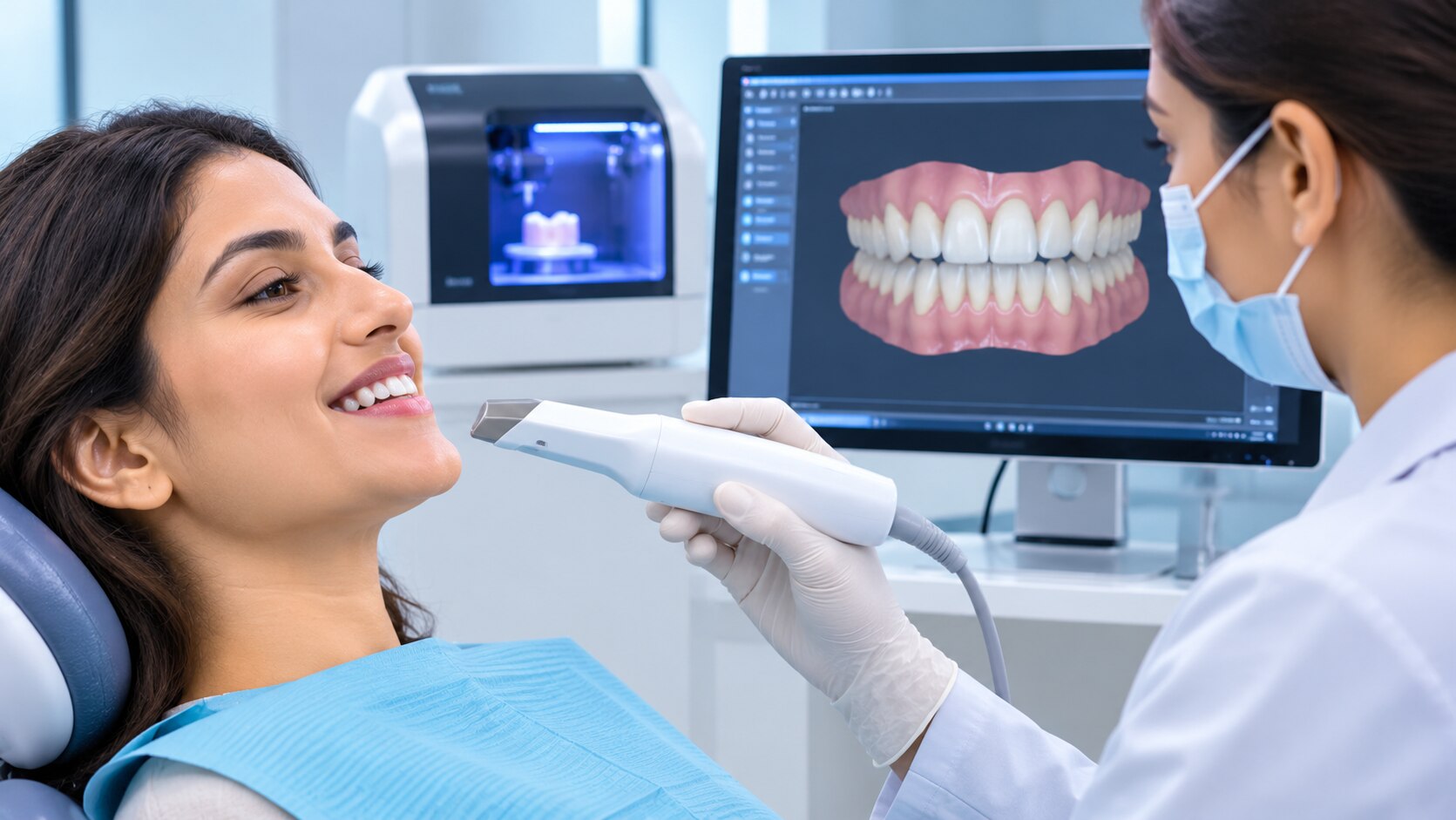
| Intraoral scanner | Visible tooth and gum surfaces, arch form and bite data | Veneers, crowns, bonding, aligners and digital models |
| Digital radiograph | Teeth, roots and supporting structures in two dimensions | Checking hidden dental conditions |
| CBCT scanner | X-ray-based three-dimensional views of roots, jawbone, impacted teeth and implant sites | Implant planning or investigating complex anatomy |
| CAD software | Digital records converted into proposed tooth shapes | Designing restorations, mock-ups and guides |
| Milling system or 3D printer | Physical models, provisionals, guides or restorations | Producing the planned treatment |
| Guided-treatment software | Coordinated implant, orthodontic or preparation data | Controlling placement, tooth movement or reduction design |
An intraoral scan and a CBCT scan are not interchangeable. The first records surfaces without X-rays; the second examines structures beneath the gum. CBCT is not automatically needed for whitening or straightforward veneers: request the specific diagnostic reason before accepting it. That distinction separates technology used for cosmetic dental treatment from a visual preview alone.
What happens during cosmetic dental scans and planning?
Cosmetic dental scans and planning begin with a clinical examination, not a scanner. Digital records support decisions; they do not detect or treat every problem on their own.
1. The clinician checks for caries, gum inflammation, cracks, tooth wear, pulpal health, occlusion, hygiene and parafunction such as clenching or grinding. Treating veneers or crowns over untreated disease can cause failure that no digital workflow can prevent.
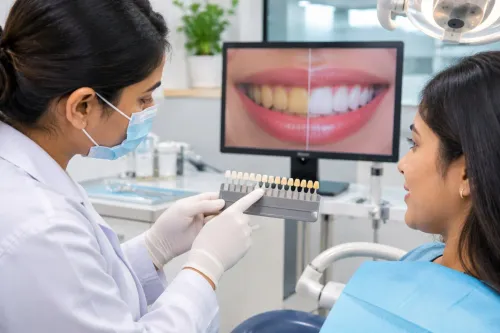
2. Standardized facial and intraoral photographs record tooth display, facial proportions, lip position and existing conditions. Shade records are taken before prolonged isolation dehydrates the teeth and makes them appear lighter than they are.
3. An intraoral scanner captures visible tooth and gum surfaces, arch form and bite information. The clinician also records how the upper and lower teeth meet, because a visually attractive design can still create uncomfortable or damaging contacts.
4. Facial analysis adds lip movement, tooth display and facial reference lines. During digital smile treatment planning, software compares tooth width, tooth length, gingival display, dental midline and incisal-edge position with the face and lips.
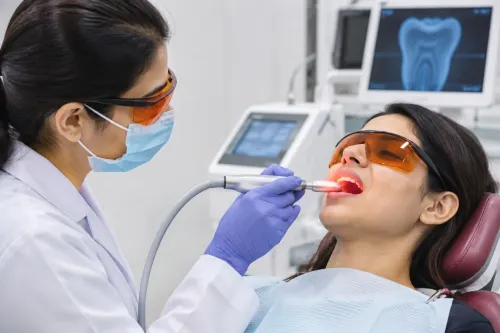
5. The clinician adds digital radiographs or a low-dose CBCT scan when roots, bone, impacted teeth, complex anatomy or implant positioning require assessment. CBCT uses X-rays and is not automatically needed for whitening or straightforward veneers.
6. The laboratory receives scan files, photographs, measurements and written instructions. Ask whether the scan supports only a screen preview or also fabrication; those are different levels of digital workflow, and the final restoration should be checked against the approved plan.
How does a digital smile plan become a real restoration?
A computer-generated smile becomes a real restoration only after the proposed design is tested on teeth, not just displayed on a screen. Digital smile treatment planning uses cosmetic dental scans and planning to propose contours, but the mouth must validate those contours before final veneers, crowns or bonding are made.
1. The CAD design is converted into a printed model, additive mock-up, digitally fabricated trial restoration or temporary restorations placed in your mouth.
2. You assess tooth length, speech, lip movement, tooth display at rest, facial expression and comfort. A shape that looks balanced in a photograph can feel too long when you speak or smile.
3. The approved design may produce a reduction guide, surgical guide, provisional restoration or laboratory instruction sheet. These outputs transfer measurements and contours to tooth preparation, implant placement or fabrication.
4. Your clinician and laboratory then refine the restoration for fit, bite, shade, translucency and surface texture before final manufacture and fitting.
A digital preview is a simulation, not a guarantee. It depends on assumptions about tooth movement, gum levels, ceramic or composite thickness, lip posture and lighting; the final appearance can change when you smile, speak or move. Material translucency and surface texture also affect colour.
A guide transfers a plan but does not eliminate error. Seating, manufacturing tolerances, scan registration and surgical execution still matter. Ask to approve a physical mock-up or provisional when tooth shape or length is your main concern.
Which scans and planning steps fit each cosmetic procedure?
The right technology used for cosmetic dental treatment depends on the procedure, not on a universal digital package.
| Treatment | Records and planning | Main limitation |
|---|---|---|
| Whitening | Clinical examination, photographs and shade documentation | A CBCT scan adds no useful information for routine whitening. |
| Composite bonding | Photographs, intraoral scan, digital wax-up and a printed guide for consistent additive shape | The guide improves consistency but does not replace clinical finishing. |
| Veneers or crowns | Photographs, shade analysis, intraoral scan, bite records, CAD design, mock-up and laboratory milling or printing | The final result still requires clinical fitting, occlusal checks and approval. |
| Orthodontic or aligner treatment | Scans, photographs and staged-movement software | Wear time, attachment failure, periodontal limits and refinements can change the predicted sequence. |
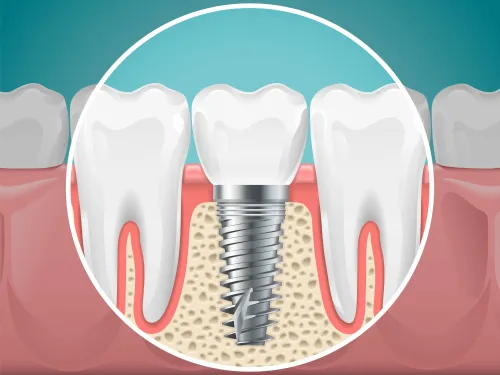
| Implant-supported cosmetic rehabilitation | CBCT merged with an intraoral scan, virtual implant planning and a surgical guide | Guide seating, registration, manufacturing tolerances and surgical execution can create deviations. |
Spectrophotometers, colorimeters and standardized photography make shade records more repeatable. Check the shade clinically because dehydration, ambient light, surrounding colours, translucency and ceramic surface texture can still produce a visible mismatch.
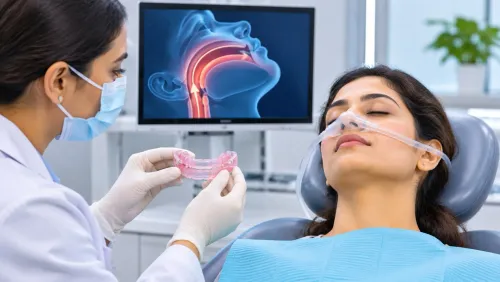
A desktop 3D printer can produce diagnostic models, mock-ups, provisionals, occlusal appliances and surgical guides. Printed resin requires the correct validated resin, printer settings, washing, post-curing and quality control; it is not automatically a definitive restoration.
Same-day CAD/CAM depends on the material, milling and finishing equipment, crystallization or firing, shade characterization and occlusal checks. Digital cosmetic dentistry in Mumbai may mean only photographs and scanning, or a complete scan-to-CAD/CAM workflow, so ask which steps are actually included.
What should you ask before choosing a digital cosmetic workflow in Mumbai?
Compare the workflow, not the device count. In digital cosmetic dentistry in Mumbai, ask what each record will decide and whether cosmetic dental scans and planning lead to manufacture or only a screen preview.
| Device or step | Ask | Evidence to expect |
|---|---|---|
| Intraoral scanner and CAD | Will the scan be used for manufacture or only visualisation? | A laboratory file, design record or clear explanation |
| Design review and trial | Who reviews the CAD design, and is a physical mock-up or provisional included? | A named clinician and an in-mouth approval stage |
| Shade recording | How is shade recorded and rechecked before fitting? | Standardised photographs, shade measurements and clinical confirmation |
| CBCT | What finding requires it, what area will be scanned, and how is dose kept as low as reasonably achievable? | A specific reason and a limited scan field |
| Implant planning | How are CBCT and intraoral data merged, and how is guide fit verified? | Registration checks, seating verification and a contingency plan |
| Final restoration | What happens if it differs from the approved design? | A defined review, adjustment or remake process |
IRIDIA DENTAL can be useful when these answers sit inside a documented examination-to-fitting workflow rather than a smile-image presentation. The decisive test is whether every scan answers a clinical question and whether the plan is checked in your mouth before definitive treatment.
Related services
Technology-Driven Services We integrate digital innovation at every step—from diagnosis to treatment—to make your dental visits smoother, faster, and more precise. View service → |
Smile Design & Facial-Driven Dentistry Smile Design & Facial-Driven Dentistry At Iridia Dental, our cosmetic dentistry services combine advanced technology with artistic precision to create smiles that are not only beautiful... View service → |
Frequently asked questions
Which digital devices are included in cosmetic dental care?
Cosmetic workflows can include intraoral cameras, digital scanners, dental photography, X-ray systems, cone beam computed tomography and computer-aided design and manufacturing equipment. Each captures different information.
What happens during cosmetic dental scans and planning?
The dental team records your teeth, gums, bite, facial proportions and treatment goals. Software combines selected records into a digital smile plan that can be reviewed before treatment.
How does a digital smile plan become a real restoration?
The approved design guides preparation, temporary restorations and the final production process. The restoration can be designed digitally and then milled, printed or fabricated by a dental laboratory before fitting and adjustment.
Which scans and planning steps fit each cosmetic procedure?
The workflow depends on the procedure. Veneers and bonding focus on photographs, tooth scans and bite records, while implants can require three-dimensional imaging. Ask why each scan is needed.
What should you ask before choosing a digital cosmetic workflow in Mumbai?
Ask which devices will be used, who reviews the records, how you can approve the design, whether a temporary preview is available, and how the final restoration will be checked and adjusted.
Keywords